


To see if this custom-fit item will work for you please tell us what vehicle you'll use it with.


Thank you! Your comment has been submitted successfully. You should be able to view your question/comment here within a few days.
Error submitting comment. Please try again momentarily.
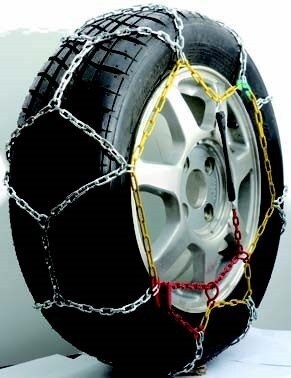

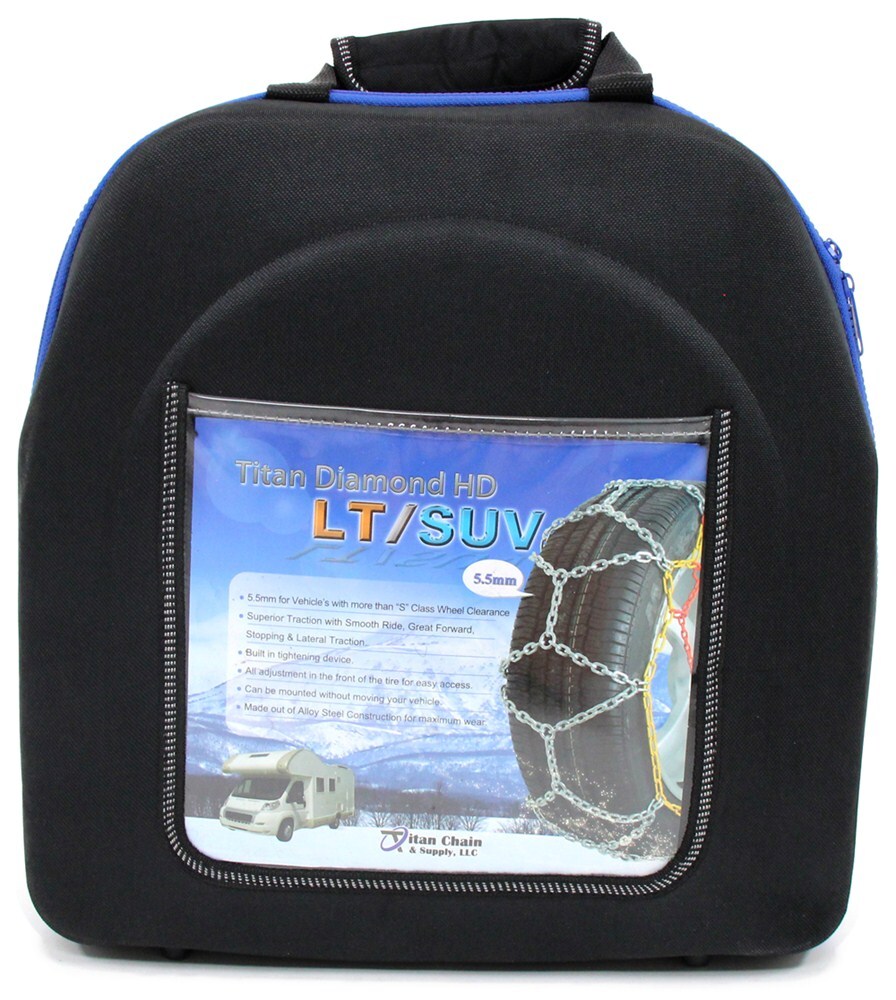


When the snow piles up or the road turns icy, the diamond-pattern design gives you consistent traction every time the tires roll. The square links bite firmly into packed snow and slick ice, while the diamond layout spreads that grip evenly for a smoother ride than ladder-style chains. It’s a reliable setup for climbing steep driveways or staying steady on rural winter roads.
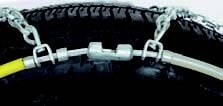
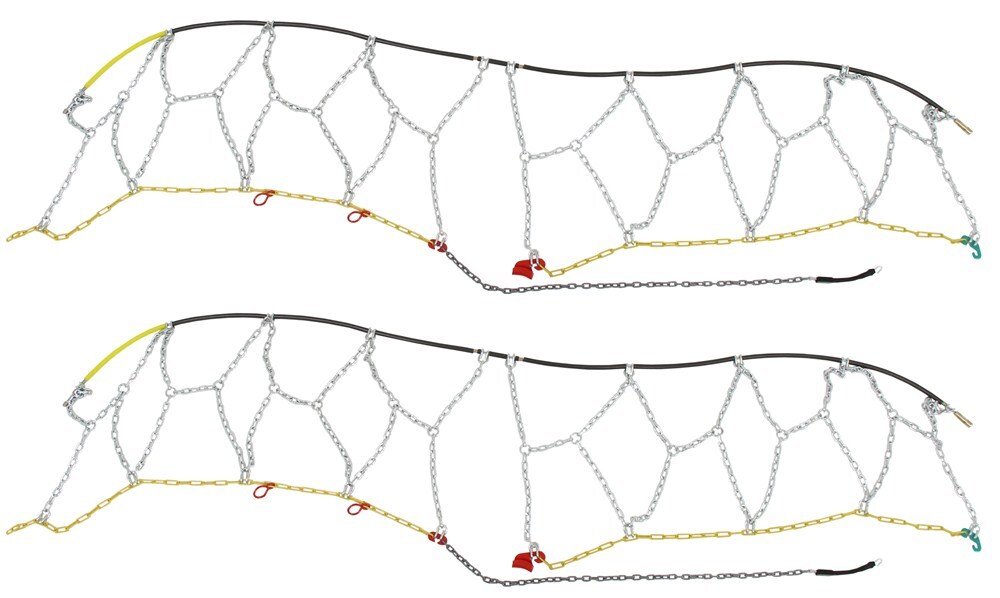
No one wants to wrestle with loose chains in freezing wind. With these Titan Chain snow chains, the tensioning system is built right in. Just hook them up using the color-coded clips, pull the tensioners tight, and you’re ready to roll. There’s no need to crawl around on the ground or worry about losing extra parts. Once tightened, they stay centered and snug so you can focus on driving instead of constant adjusting.


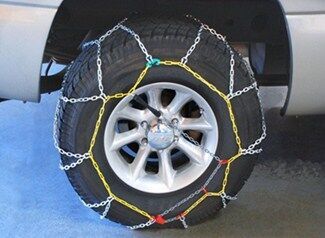
These chains are built from a manganese nickel alloy that resists wear and corrosion. The 5.5 mm (0.216") thick links are heavier duty than most low-profile designs, so they’ll stand up to regular winter use without rusting or stretching out. They’re tough enough to handle deep snow and icy driveways season after season while staying smooth and flexible when you need them.
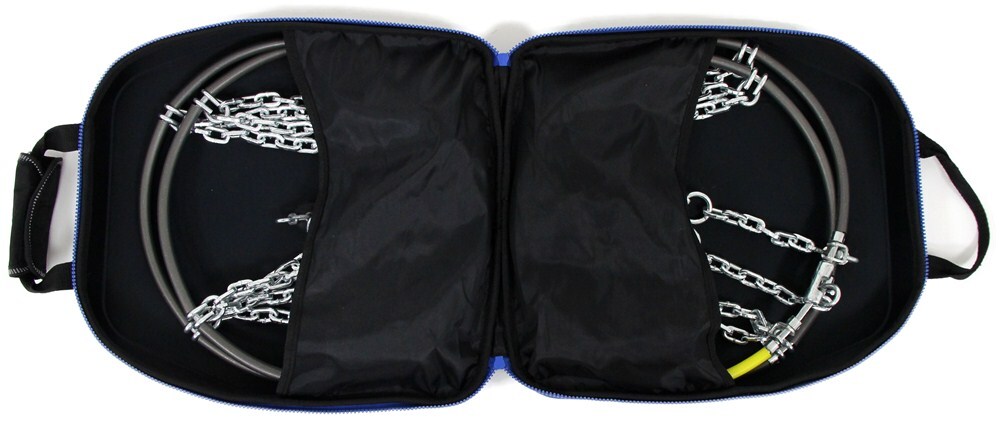
Even with their solid construction, these chains are surprisingly compact. They fold up neatly into the included reusable storage bag, so you can keep them tucked away in your vehicle until you need them. That makes them great for occasional winter trips or as a dependable backup for unexpected storms.
If you run different tire setups or just want something versatile, this pair fits tires from 15" to 17-1/2" in diameter. Each set includes two chains, ready to install when snow starts falling. It’s a straightforward fit that gives you reliable grip without adding bulk.
These chains fit the following tire sizes:
Videos are provided as a guide only. Refer to manufacturer installation instructions and specs for complete information.
Hello neighbor, this is Curt with Etrailer and today we're gonna take a look at these Titan Snow tire chains on our 2025 Chevy Silverado 2500 with the 245 over 75 R-17 tires. Now tire chains are really the best way to ensure that you're gonna be able to drive through that ice and snow safely. It'll help you with the traction and in the case of these, it's gonna help you with some of that lateral movement and slipping as well. This is an assisted tensioning tire chain. Now there's three different tire chains really you can get. There's a manual tensioning, which means all of the adjustment is gonna have to come from your strength alone.
You can also, in fact, it's recommended that you also use one of these type of tensioners with it, which is gonna hook on all around the edges. And in the case of these chains from Titan, one of the coolest things about it is how they kind of get put these bright colors everywhere. A lot of times when you're putting on snow chains, you're gonna be in some low light conditions. It's common during winter anyway, and being able to see where all of your connections are and where any adjustments might need to be made can be crucial. It's a nickel manganese alloy, so you're not really gonna have to worry about any kind of rust or corrosion with 'em.
They're gonna be really, really resistant to that. So that's great because things like road salt when there are icy conditions can, you know, really do some damage to a lot of different metals. One of the other great things about it is that it is what's called a square link. So the links aren't perfectly round. They've got some edges to 'em that's really gonna help bite into that ice and keep you from slipping.
And the last thing I wanna talk about is the design itself. So these are what they call a diamond pattern and that just means that the links kind of come out like that in a diamond. We have the center link going around as well and that's what's really gonna help us out with that lateral side to side slipping. These are gonna be great for forward and backward traction, but having that added bonus of not having to, to worry about it slip out to the side on you is also something that's gonna give you a lot of peace of mind going down the road. The other type of design that you might see in tire chains is what they call a ladder pattern.
Those go straight across the tire. Now while those are excellent for that forward and backward traction, they don't do as much to avoid that sideways slipping. And the other great thing about this is that again, you don't have to crawl up under here and get all messy in the snow really to, to get these on and get them adjusted. Any adjustments that you need to make are gonna come from the front. The only thing that you're gonna have to do as far as being underneath the car, behind the tire is just feed it around and I'm gonna show you exactly how we got these on right now. Now when it comes to installation, the first thing I wanna do is lay my chains out for inspection. I am wearing gloves for this even though I'm indoors. A couple reasons for that. One, there are some sharp edges to the tire chains that are gonna help them bite through that ice and snow. So I don't want to get any cuts or pinches on my hands. And two, I honestly, whenever you're applying tire chains, if you're, maybe you get these and you're trying 'em on for the first time, it's a good idea to have gloves on while you're doing it. It just makes good practice 'cause chances are, if you have to put these on in the real world, it's not gonna be very pleasant outside as far as the weather goes. So being able to do this with gloves on is a huge bonus and it'll just give you that confidence when you have to do it out there on a snowy or icy road. But with that being said, I'm laying my tire chains out flat and what I'm really looking for is any twists or kinks just to make sure that we don't have any of that going on. Those are kind of things that could damage not only your chains but your tires as well if you have those in the chain as you're going down the road. And as I'm doing that, I'm also separating these bottom portions here. I've got my tensioner on one end here at the bottom and I've got the catch for it here on the other. The other thing that I'm doing is making sure that it's facing the correct way. So where it attaches to the cable here, this link has a loop end and it's got this open hook end. I want those open hooks facing down. That way when I put the chains onto the tire itself, I can ensure that open hook end is facing away from the sidewall and it's not gonna puncture it. Now what I want to do is make sure I keep this separation and I'm going to go ahead and I'm gonna feed one end of the chains around the back of the tire just like this. I'm gonna try to keep it away from the bottom of the tire so it doesn't catch up underneath it. And we just get that kind of smooth transition going around. Now as I'm doing this, I'm also trying to make sure that I'm not twisting it up or anything like that as well. Can be a bit challenging when you have those icy conditions out on the road, but it's definitely doable. So with that end being around, I've got my tensioner end here. I'm gonna go ahead and make sure that the catch is around the front just like that. And again, don't have any kind of twists or anything like that to it. At this point, I'm gonna do my best to kind of keep control of the chain here. In the one hand, I'm gonna do the same with this end back here and I'm just gonna try to drape as much of this over the tire as I can and make this catch up here at the top just like so. Now I'm gonna bring this around the front and again, try to just drape this around, just making sure that nothing's getting twisted up or anything like that. Now up here at the top, I've got these three open links that I could use to hook this into. I'm gonna go ahead and do this from the middle link and we're gonna see how this works. This is something that could be adjusted later on and this is why I always suggest that once you get your tire chains, go ahead and try them on. That'll just make applying them on the tires that much easier and that much quicker for you when you're out there in the cold. You don't wanna spend any extra time out there making adjustments than you have to. Once I do that, I'm just gonna drape this over and I'm gonna try to get this center portion of the chain over the center of the tire as best I can. So that up and going around the tire, again, just making any kind of drape adjustments that I need to. Go ahead and give it a tug. Make sure that everything is coming off the back and up the front as best we can. We really don't want to be in a situation where we've got any of this yellow chain under the tire on the tread or anything like that. Now as I bring it around the front, I could see that it's a little bit tight in the front here. I'm gonna go ahead and go back up here to the top. So I backed it off and went to the end link right here. And now I feel a lot better about how this is draping around. As I bring these bottom portions around, the yellow chain is off of the tread and on the sidewalls all the way around. So this is a much better fit this way. So what I'm gonna do now is here at the bottom, I've got this catch here, I'm just gonna run this chain attached to my tensioner through that catch, just like that. And I can cinch it tight from there. Now what I'm gonna do is just kind of bring it up and I'm just checking to see, you know, hey, do I have enough tension if I bring it up like this And I'm kind of feeling like, no, not really. This is a lot looser than it should be. We should have some stretch to this. And again, just kind of pulling this around much tighter. So we do have these tensioning loops down here, these red loops. I'm gonna go ahead and run my tensioner through that. And this is just gonna pick up a lot of that slack that I was getting out of this so that we can make sure that we have a really good tight fit around the front. Now at this point, I could go ahead and just pull on this, make sure it's tighter against there. And while I can't really go straight across, I could still come up to this area here and hook it on. Now when I hook it on, I'm gonna make sure that the open end of this hook is facing away from the sidewall for the very same reasons that we we inchesre making sure that these links we inchesre facing away from that sidewall. But as I bring it up, go ahead and get some slack out of it. We're gonna go ahead and hook it through one of these loops right here. Now as I do that, I've got much better tension here. Now here's the thing, once we've got it on, it may feel like really good and tight as it is, but because we wrap this around the bottom of the tire, there's still gonna be some adjustments to be made. There's still gonna be some slack in it that we don't really see. So it's a good idea to go ahead and pull the vehicle up a few feet or back it up a few feet. What we wanna make sure of is that we're getting this portion off of the bottom of the tire, off of the ground. I can almost guarantee you that you're gonna be able to tighten it and cinch it up a little bit more after that. And that's really it for the installation. We didn't have to get underneath the car and make manual adjustments, making it tighter here and there. All of the tensioning is gonna come through this area right here. We do need to roll it forward and back, like I said, just to make sure that we've got it cinched up completely all around the entire tire. But compared to a manual tensioning tire chain, this is a much, much easier solution. And if you've got any questions about these tire chains or about the installation, go ahead and leave that question in the comments below. We'd love to get back to you about that. Make sure you're getting the right thing and putting them on correctly plus that knowledge, sharing that with other neighbors just like you can help them make the best decision for themselves. Once again, this is Curt with etrailer. Thanks for stopping by.
Customer Satisfaction Score:
88% were satisfied with this product
12% of customers were not satisfied
Ratings & Reviews

Ordered chains for a 2025 2500 Silverado Custom Z71 quad cap tire size LT275/65R20. I installed the chains on the rear tires to check the fitment. The chains were easy to install and were tight to the tire. It took approximately ten minutes per tire for the first install. On the inside of the tire the cable had plenty of clearance to the brake lines and calipers. They are a heavy duty chain and seem very well made. I will update the review when I can do a real test in the ice and snow.
I have no previous experience with vehicle tire chains. I ordered and received these Titan chains from etrailer in a very timely manner. The only reason for my 4 of 5 stars is that I have yet to use them. I took pictures after installing on a rear tire of my 2006 GMC Sierra 1500. LT 265/70-17. These Titan chains seem to fit very well. Etrailer's installation video helped make my 1st attempt easy and successful. Thank you etrailer!
First of all, thanks for your follow up request. Our trip through the Rockies was cut short and we didn’t use them so we can’t yet rate them in actual use. I can attest that their design for installation is great. Easiest snow chain installation I’ve ever experienced. [you do test them before actually stuck in the snow don’t you?]
That said, I can rate my experience dealing with Etrailer as most satisfying. Kudos to them for hiring excellent staff.
Great service, tracking, and follow up. Chains showed up a day early too. I ordered the Diamond chains for 265/70R17 KO'2 tires. Fit good, easy to install. Note in image that I put my tires up on blocks to install. This works quite nicely, especially with the edge lugs on the tires to get things lined up and properly fit. Much easier, cleaner, and warmer to fit chains in the garage or driveway before crawling around on ice, snow, and slush with cold hands etc...
Fits good on my truck, very easy to install. Thank you for shipping item out quickly. Got item in two days! Great job!
Titan chains are some of the best chains I’ve used. The diamond chains are really easy to install and the diamond pattern makes the ride a little smoother compared to ladder style chains. I had a pair for my Ram 1500 for about a year and decided to get another pair for my wife’s Grand Cherokee, but Etrailer doesn’t list a pair of the diamond chains confirmed to fit the 265/60/R18 tire. I called Titan chain and they gave me the model number and the TC2526 fits perfectly. Not sure why Etrailer says it doesn’t.
Chains look pretty good but could have used one more cross link since I have a large gap between chain links. Also, rubber bungee on end of chain to connect and tighten outside of chains is too stiff and can't be stretched much for tightening. A longer rubber bungee with more flexibility would probably be a better choice for these chains.
I have been using Titian Tire Chains for about ten years. Though I do not need them all of the time they perform well. That is why I ordered them for my new vehicle.
After reviewing tech info and reviews I purchased Titan Alloy Tire Chains - Diamond Pattern - Square Link part TC2533 for the 2018 Ram 2500. These are regular duty and a good fit. These chains offer a lot more clearance for the P-Brake cable. They are a cleaver design, have great carrying case and are fairly quick to install. I have not purchased winter tires for this vehicle so the Ram need chains to pull a travel trailer up and down our snow-covered road.
Easy to install. Worked great on our 2022 Nexus motorhome to get up a 2000 foot ice covered driveway.
I got the chains and tired them on tonight and they seem big. With the tension all the way tight there was still slop in the chain system. It definitely seems like they could tighten more. The instructions show a few inches of available tension when the chains are on plus I had to loop the bungee cord around another section of chain to get any tightness. It just does not seem like the proper fit and may cause issue when in use. Is there a smaller size or another tire chain that would better fit a 275/65R18 tire???
These chains are Awesome in every way! I live at 7500' on a mesa in W.new mexico, winter is get to town in the morning early while the roads are still frozen. . . otherwise its mud\snow\rock\ice, in a steady uphill climb. . . These chains go on so fast, (like 5min for a set). I use them on a 2001 AWD\4WD Expedition... FRONT end only and while I get some rear end sliding, the fronts just never break loose at all
Etrailer has always provided the products I needed at a price and delivery expected
Didn’t fit tire/wheel combo listed as c ompatible
No snow yet but the practice installation went great! So simple my 6 year-old helped make sure I was following the instructions properly. Time will tell if I need them and how they work in the upcoming North Idaho snow plowing season. Fit great on my 275/70R18 tires. I appreciate the carrying case they came with, also!
The Titan Tire Chains fit the rear axle with adequate clearance. The front wheels only have about 5/8" between the inside cable connection and upper control arm. I would not recommend their use on the steer axle. The wheels are factory wheels for the Denali trim level. I cannot comment on traction nor durability as they have not been required to be used this winter.
Purchased for my 2012 Ram 3500 just in case snow got too bad for 4x4. Didn’t end up needing them on this trip but I did practice installing them since I’ve never installed chains before. Super easy. Took less than ten minutes. Happy with the purchase and id recommend them for a noob like me.
These chains (TC2533) worked perfectly on my 2026 GMC Yukon AT4 with 275/60R20 tires. After several days of driving in fresh snow using 4WD (without chains), the sun came out and the conditions turned icy the following morning. To safely reach the main road, I had to install the chains.
Installation was straightforward and went on with minimal effort. I then drove up an icy side road and approximately three miles on a snow-covered road without any issues. I used tensioners to keep the chains tight and prevent shifting.
Although GMC does not recommend using tire chains on the Yukon with this tire size, I experienced no rubbing or damage. As a tip, I always carry a couple of 8-inch-long pieces of 2x4 wood to drive onto during installation. This makes it easier to position and adjust the chains while installing them.
PERFECT!!!!
So far so good. I seldom use chains, yet I like having them for occasional use. If you're a contractor and going to be doing a lot plowing I would suggest getting something else. These are not what you're looking for. They are light duty.
Fast delivery. When I got the chains, I went out the next day and put them on, just so that I would be familiar with them, in case I needed to put them on in an emergency. They went on very easily... I was very impressed.
I’m really happy with these chains. They are easy to install and have great traction. They are the best chains I’ve ever owned. I haven’t used them enough to know how well they hold up, but they seem to be made very well.
Adam was very helpful, ensuring that I ordered the correct for chains for the tire size on my truck. The delivery was very fast. I will order from Etrailer again. I haven't yet put the chains to use, so I can't get evaluate them, but they were as described and should work well.
Hav not had to use them yet..but they look good. The service from etrailer was great. They kept me informed from order to delivery and the tracking was great too.
Info for this part was:
At etrailer we provide the best information available about the products we sell. We take the quality of our information seriously so that you can get the right part the first time. Let us know if anything is missing or if you have any questions.





















Doc K.
2/13/2015
They have been great. I wore out 2 sets of regular chains last winter before I got these. Real easy to put on and have done a great job.